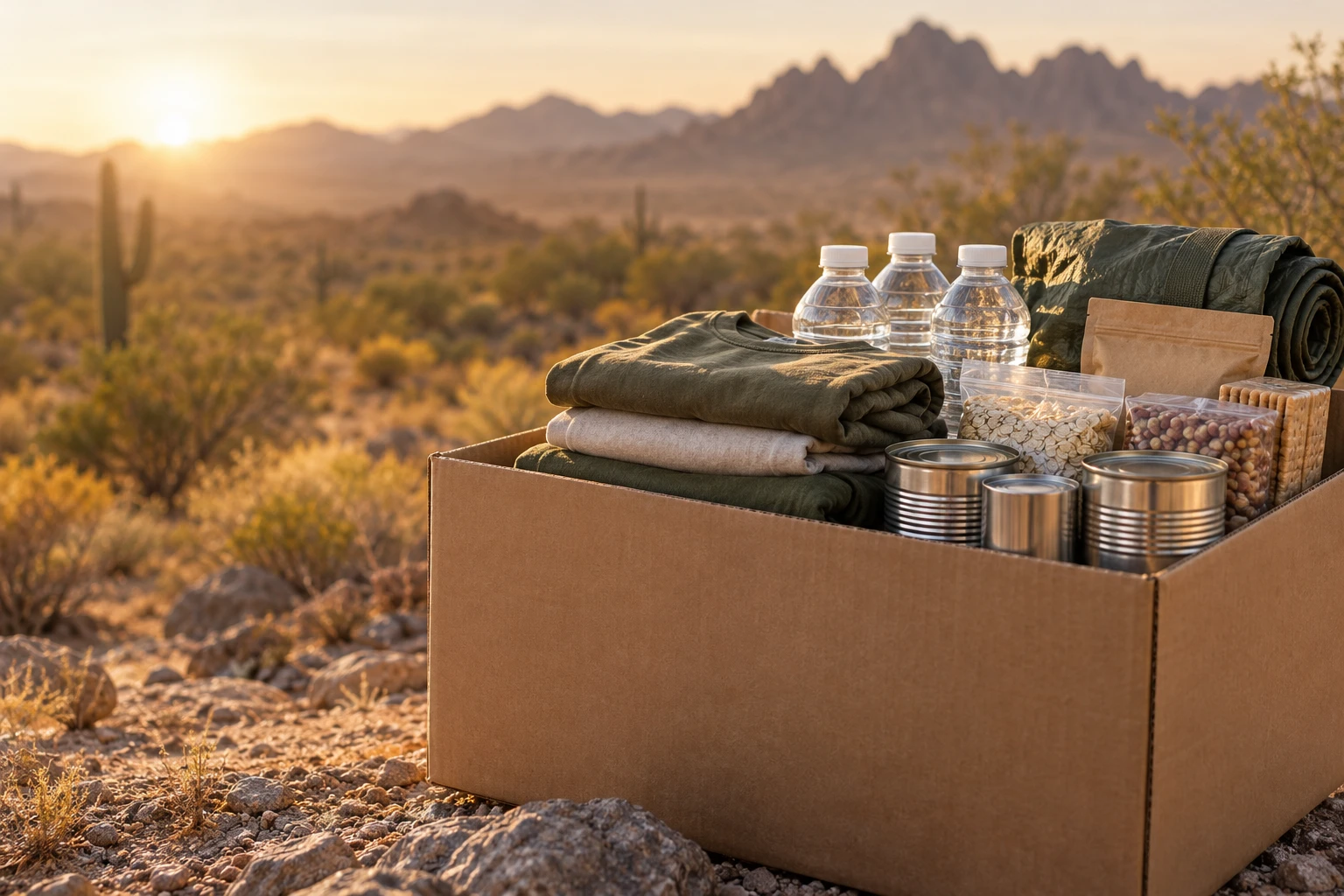
VetLogistics is being developed for unhoused veterans, especially those who cannot readily access VA services. The starting point: water, food, clothing, and tarps, coordinated through grassroots providers.
✳ Three Settings. One Purpose. Skid Row · Phoenix · Portland
Illustrative concept imagery
Small Essentials. Meaningful Connection.
Water
Food
Clothing
Tarps & Cover
01 / Who We Aim to ReachDignity Before Anything Else
Why Not Simply Go to the VA?
Getting help can take more than finding an address.
Some veterans face discharge-related eligibility restrictions. Others face practical barriers to reaching care or following through. The response should fit the person.
VetLogistics starts with everyday essentials and a respectful human connection. Housing and service referrals would remain a choice, never a condition of receiving supplies.
01 / Eligibility
Understand the Options.
A dishonorable discharge generally bars VA benefits for that period of service. Eligibility after a bad-conduct discharge depends on the court-martial type and program: a special-court-martial bad-conduct discharge does not itself exclude someone from designated homelessness programs such as HUD-VASH. Other qualifying service, legal exceptions, and program requirements need individual review.
02 / Practical Access
Make the Connection Workable.
The proposed approach would check the receiving team, transportation and appointment needs, and referral follow-through. Phone and in-person alternatives should remain available.
03 / Individual Care
Respect the Whole Person.
Clinical needs vary and may overlap. Coordination should respect each veteran’s priorities, existing care relationships, and choice.
Build on the Support Already There.
Community and VA resources can complement one another. Los Angeles service models include housing-related support, case management, and clinical care. VetLogistics proposes clearer connections alongside that work.
This practice-informed framing draws on the developing article Pathways Beyond Exclusion. It is not a published VetLogistics outcome study or an individual eligibility assessment.
Program-specific eligibility:VA’s July 29, 2026 notice, p. 47919 (PDF) and 38 U.S.C. § 2002(b) describe broader eligibility definitions for specified homelessness programs. Their veteran definition excludes dishonorable discharges and discharges or dismissals by general-court-martial sentence. General benefit rules and exceptions appear in 38 C.F.R. § 3.12. A qualified adviser should review the actual service record and program.
Sources reviewed October 15, 2026. The original concept is grounded in the August 2025 USC DSW capstone, Using Data Science to End Veteran Homelessness. No institutional endorsement is implied.
Why This Matters HereMaricopa County · Heat & Homelessness
No One Should Face Extreme Heat Alone.
In Maricopa County, heat-related deaths are a stark reminder that everyday essentials and access to support matter for people living outdoors.
This local context informs VetLogistics’s proposed coordination of water and essential supplies for unhoused veterans.
2026 Update · Preliminary · All Countywide Heat-Related Deaths
The county recorded 389 confirmed deaths through the week ending . The county dashboard reported 44% among people experiencing homelessness; 383 deaths were still under investigation.
Dashboard updated . These incomplete current-year figures are separate from the 2025 full-year count above.
Read the figures in context. The homelessness figures are not veteran-specific. The 2025 homelessness count and the 2026 countywide total cover different periods and populations; they are not a like-for-like annual comparison. No exact 2026 homelessness count is inferred from the rounded percentage.
Research Points to Barriers to Relief.
In an ASU study of 40 adults aged 55 and older experiencing homelessness in Phoenix, only one in four said they could always avoid heat when they wanted to. This small study is not a veteran-specific or population-wide estimate.
A clear, low-barrier request would let a veteran choose the everyday essentials they need.
2
Connect With a Provider.
The concept brings requests and grassroots providers together, with a meeting location shared only by choice for that request.
3
Build Trust, One Interaction at a Time.
Providers would share clear updates, explain delays, and support respectful, reliable handoffs.
03 / Three Exploratory Use CasesLocal Context. Shared Purpose.
Different Settings. The Same Human Priority.
These three settings would be investigated with veterans and local services. Skid Row is our leading setting for initial listening and feasibility assessment.
Urban Last-Mile Coordination
Downtown Los Angeles · California
Skid Row
Leading Candidate to Investigate
Explore request timing, comfortable meeting points, and clear handoffs within a compact urban area.
The Design Question
Could clearer handoffs help veterans reach support they want?
Existing services include the Skid Row Care Campus. Local input and existing outreach would guide this scenario.
Three use cases to explore. One bounded first pilot. These are proposed settings, not confirmed pilots, service areas, or first-year operations. A first pilot would involve one partner and one site, both still to be determined.
Technology would complement human outreach, not replace it. Local input, provider capacity, consent, and safety would guide any next step.
Autonomous transport remains a separate feasibility question in each setting. Passenger ride services do not establish supply-delivery integration, and no autonomous service availability is assumed for Portland.
04 / Technology With a Human Purpose
A Simple Interface. A Meaningful Connection.
Explore illustrative screens showing how the proposed request experience could work.
05 / The Next HorizonA Future-Mobility Research Vision
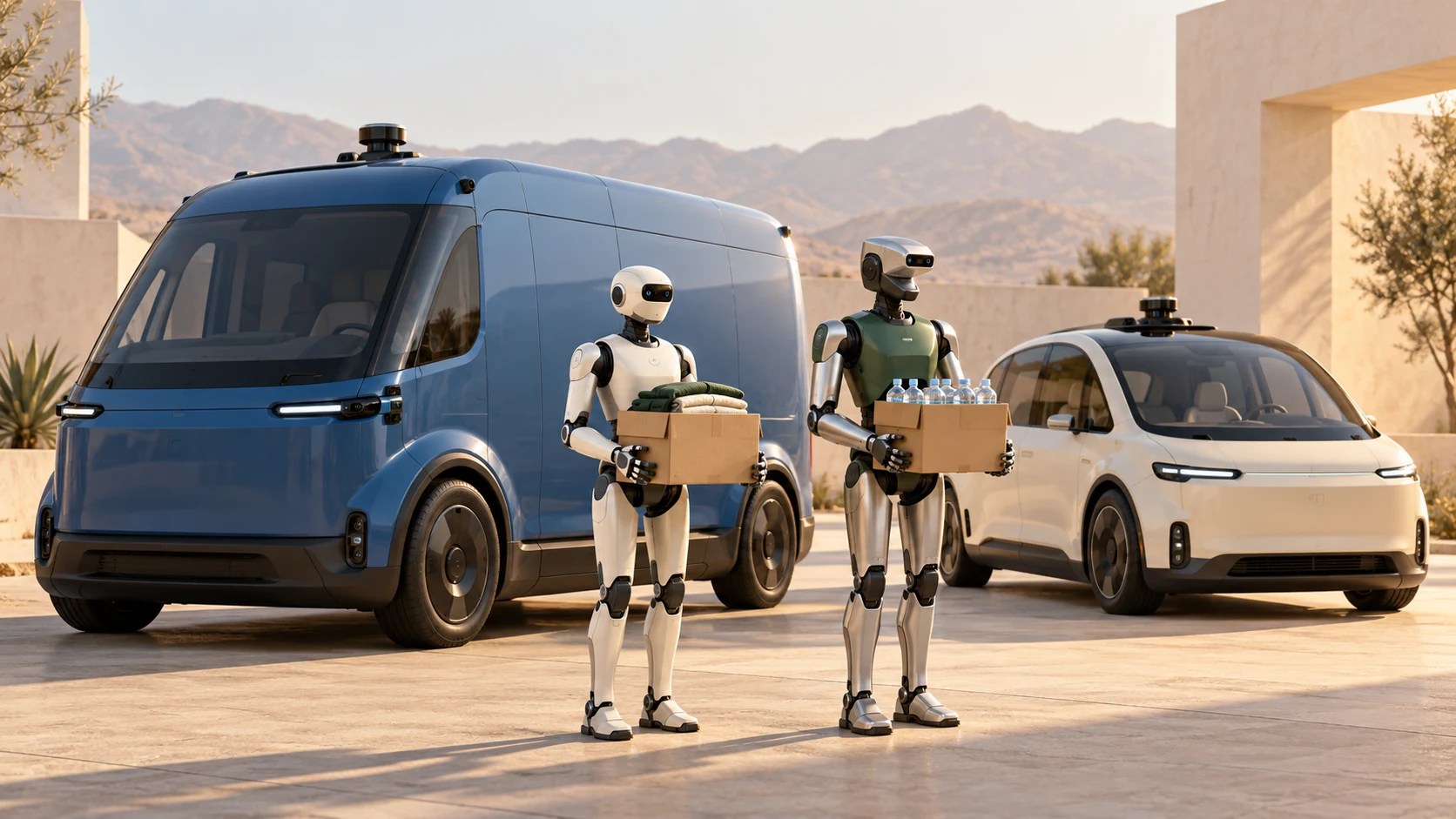
Self-Driving Vehicles + Humanoid Robots
Forward Thinking. Human at Heart.
Imagine supplies reaching the last mile, guided by the people they serve.
Beyond the developing app, the long-term vision explores self-driving vehicles and humanoid robots working alongside grassroots providers to move essential supplies.
Future ConceptCoordinate · Move · Connect
Original concept illustration, not manufacturer imagery or an operational fleet.Explore the Technology References +
These companies are not confirmed VetLogistics partners.
References reviewed October 15, 2026. No availability, integration, or deployment date is promised.
Exploring Access to Care
A Ride Toward Better Access.
Could autonomous rides help veterans reach nonemergency medical appointments? Research would need to assess accessibility, eligibility, human assistance, supervision, and reliable handoffs.
Emergency care requires emergency services. This concept is not an ambulance service.
Rooted in the original vision. The 2025 capstone’s Action Plan (p. 38) and Appendix G (p. 68) connect robotics and autonomous vehicles with supplies, transportation, and access to resources.
Future mobility remains separate from the app currently in development. Feasibility, safety, permissions, and human oversight come before any bounded pilot. No technology partnership, operational fleet, round-the-clock availability, or deployment approval is being announced.
The next step is to develop the app with input from veterans, outreach teams, and people who can help turn the concept into a carefully tested service model.
The public website is live, with the proposed service model, illustrative app screens, and research behind the vision. App development has begun; the app still needs development and testing before it can support real requests.
Collaborators Who Can Help Move This Forward
We’re looking for people who can help answer practical questions before a pilot begins.
01Listen
Veterans and Outreach Teams
Help identify real needs, workable handoffs, and barriers to using an app or reaching services, including phone and in-person alternatives.
Success would need to be demonstrated through practical results and the experiences of the people served.
Practical Access
Can veterans understand and use the request process, including when they need assistance?
Request Follow-Through
Can providers complete supply requests and, with consent, confirm that a referral reaches a receiving service?
Veteran Experience
Do people feel respected, informed, and in control of their choices?
Funding and partnerships have not been confirmed. This is not a fundraising campaign, and no service outcomes are guaranteed.
07 / Where Things StandClarity Matters
A Vision in Progress. An Honest Starting Point.
This informational website explains the proposed approach and invites collaborators to help develop it.
Not Accepting Service RequestsNo live delivery service is confirmed.
Can I Request Supplies Through This Website?+
No. This is an informational website. It does not accept supply requests, collect personal information through forms, or coordinate deliveries. Please do not rely on it for urgent assistance.
How Would Location Sharing Work?+
A working app would still need validated privacy and security arrangements before optional, request-specific location sharing could be offered. This website does not request your location.